





April has more movement than March. Python remains far ahead, but its rating continues to slide, while C adds another strong month in second. Most of the top 10 keeps the same order, though the numbers in the lower half soften enough to keep that bottom tier on watch.
The TIOBE Programming Community Index tracks programming language popularity using search engine activity.
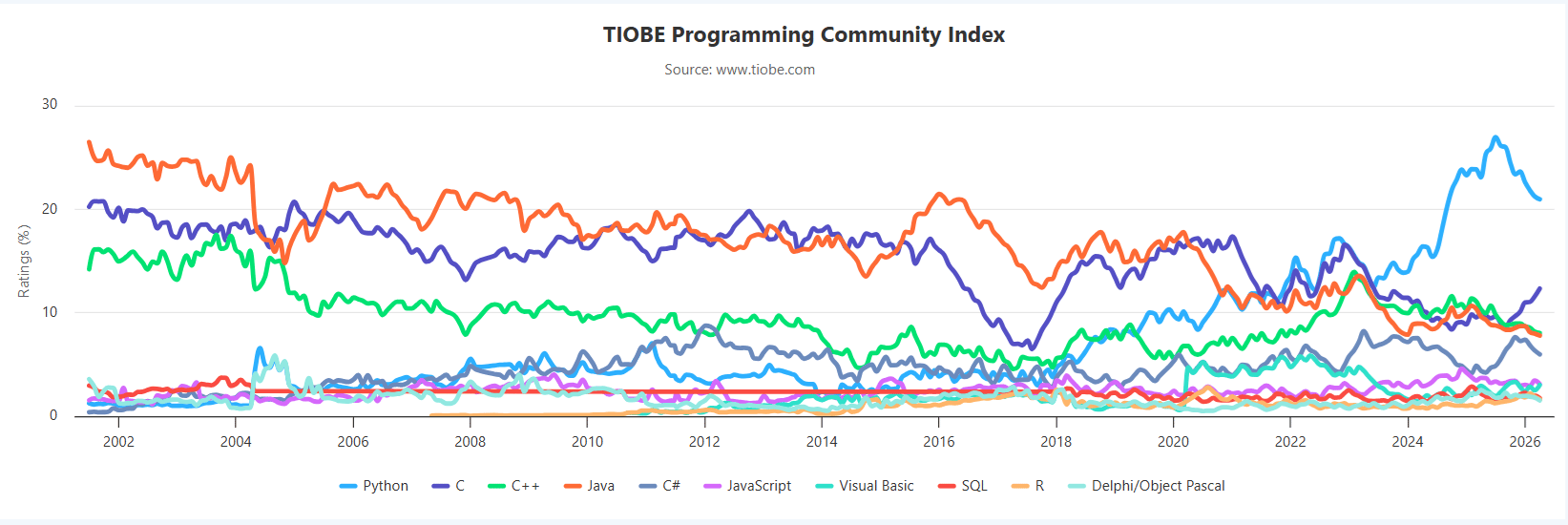
Python stays dominant as C keeps gaining ground
Python holds first place at 20.97%, down from 21.25% in March. The lead is still enormous, but April extends the run of month-to-month declines.
C rises to 12.34% from 11.55% in March. At this point, second place looks increasingly secure for C, while the next three languages remain clustered behind it.
C++ and Java soften, and C# dips while keeping its longer-run lift
C++ posts 8.03%, down from 8.18% in March, and Java comes in at 7.79%, down from 7.99%. The order stays the same, but neither regains momentum this month.
C# remains fifth at 5.98%, down from 6.36% in March. Even so, the April table lists C# with a positive year-over-year change (+1.59%), which fits the broader story that C# continues to attract attention over time, even if it doesn’t rise every month.
Visual Basic jumps as JavaScript slides
JavaScript holds sixth at 3.11%, down from 3.45% last month. Visual Basic moves the other way, rising to 3.02% from 2.50%. That’s one of the bigger month-to-month rating moves outside the top five, and it stands out precisely because this part of the list usually changes slowly.
SQL and R keep their order as the bottom of the top 10 tightens
SQL remains eighth at 1.75%, down from 2.00% in March. R stays ninth at 1.62%, down from 1.88%. They keep the same order as last month, but the general drift is downward across this tier.
Delphi/Object Pascal rounds out the top 10 at 1.52%, down from 1.80% in March. With ratings this close together, that last slot can change quickly if any contender outside the top 10 gets a modest lift.
Rust looks farther from the top 10 than many expected
Paul Jansen uses April to revisit Rust’s trajectory. Rust is the youngest language in the TIOBE top 20, and after it entered the top 20 in June 2020, many assumed it would be on a straight path into the top 10 as a serious rival to C and C++.
Rust did reach its best-ever rank at #13 earlier this year, but it has slipped back to #16 in just a few months. Jansen points to a familiar hurdle: the programming language can deliver efficient, safety-focused code, but it remains tough for non-experts to learn. Developers in performance-heavy areas will invest the time, but that learning curve makes widespread adoption harder to sustain at the pace people once predicted.
The top-10 door looks harder to push open
Rust’s slide is a useful context for the perennial “who breaks into the top 10 next?” conversation: momentum alone doesn’t guarantee a breakthrough if the learning curve keeps the audience narrow.
If Rust keeps hovering in the mid-teens, the pressure for change shifts back to the crowded bottom of the top 10 instead of a new entrant forcing its way in.
Google is turning Gemini into more of a workspace with NotebookLM-style project organization built in.
Read the full article here