



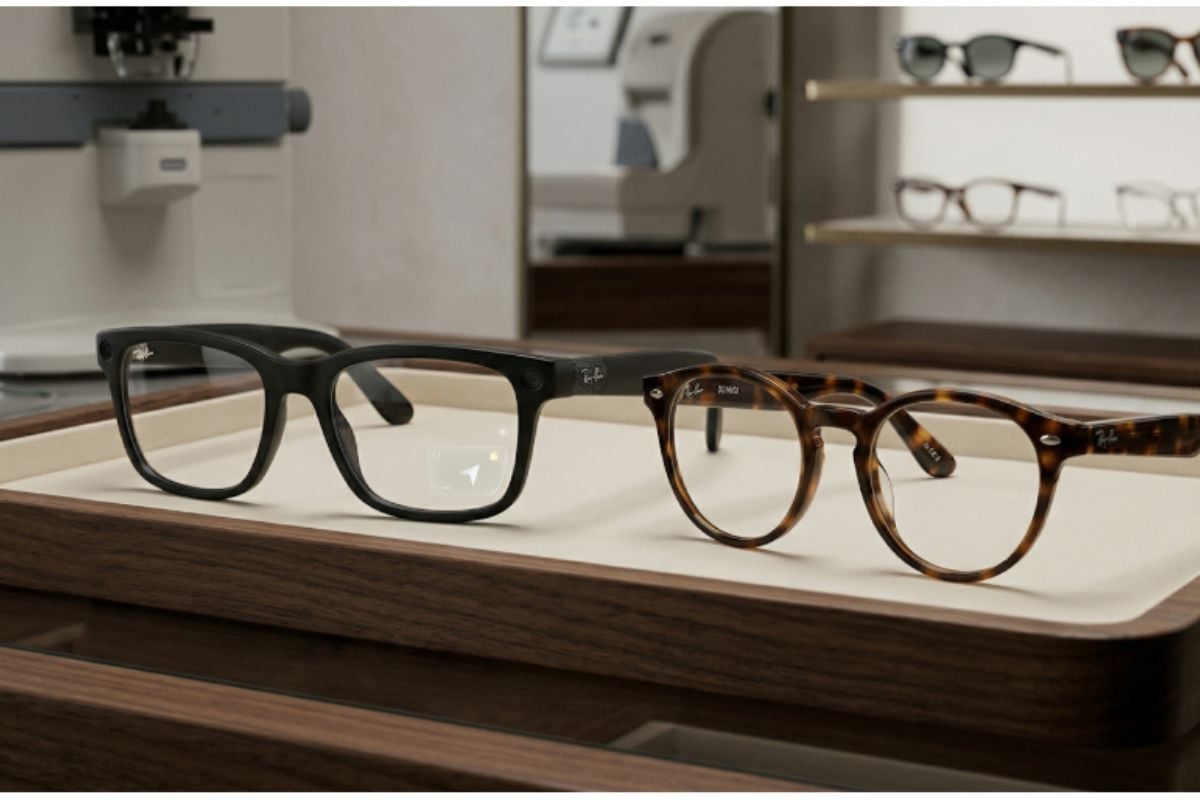

Meta is preparing to launch two new Ray-Ban smart glasses next week, with versions designed specifically for prescription users.
While the glasses have previously supported prescription lenses, these two models have been purpose-built and will be marketed exclusively for this segment. EssilorLuxottica, the holding company behind Ray-Ban and several other eyewear brands, plans to sell the glasses through optical stores.
The smart glasses were spotted by The Verge in FCC filings under the codenames Scriber and Blazer. They will come in both rectangular and rounded styles.
Meta is deepening its partnership with EssilorLuxottica, the company responsible for Ray-Ban and a range of other eyewear brands. It invested $3.5 billion in the firm for a 3% stake in June 2025 and, shortly afterwards, launched its first model with a built-in display, the Meta Ray-Ban Displays.
AI to power smart glasses market
The social media giant is expected to launch several new models this year, with a strong focus on integrated artificial intelligence services. Users may be able to talk to Meta AI through the glasses, allowing it to see what is in front of them and enabling more contextual responses.
Meta sees smart glasses as a market where it has an edge over rivals, having sold 7 million units in 2025. It also appears comfortable with its relationship with EssilorLuxottica, giving it significant control over the design and retail distribution.
While it has an early lead, rivals are expected to launch competing devices this year. OpenAI has its smart pendant or speaker lined up for the second half of 2026, and Apple is reportedly rerouting teams to accelerate production of its smart glasses and other AI wearables. Google also plans to relaunch its Glass operations, albeit with an entirely new design and approach.
Virtual reality on the back burner
Even though virtual reality was once seen as a market alongside smart glasses, the two have increasingly diverged due to the rise of AI. Cumbersome VR headsets are not aligned with the aims of an AI device, which should be lightweight, always-on, and non-intrusive. This appears to be Meta’s thinking, as it has deprioritized VR and the metaverse in favour of smart glasses and AI.
This also seems to be the view of other tech giants. Apple has shifted some focus away from VR, particularly the Vision Pro, in favour of lighter wearable devices. Even Microsoft, which debuted the first HoloLens in 2015, discontinued production of the device in 2024 in favour of increased investment in cloud and AI.
The only market likely to sustain VR in the next few years is gaming. Sony launched the PlayStation VR2 in 2023, and Valve is expected to launch the Steam Frame this year.
For more on how Meta is evolving its social and monetization strategy, check out its latest test of paid Instagram Story features.
Read the full article here