


Why you can trust TechRadar
We spend hours testing every product or service we review, so you can be sure you’re buying the best. Find out more about how we test.
V-Copter Falcon Mini: one-minute review
From ZeroZero Robotics, the drone company responsible for the impressive HoverAir X1 Pro and ProMax selfie drones, comes another interesting model: the V-Copter Falcon Mini. This is a sub-250g version of the V-Copter Falcon, which was released in 2020 and weighed 26.8oz / 760g. The original Falcon was admired for its unique design, and gained a cult following, but it never quite made it into the mainstream.
The advantage here is that the Falcon Mini is extremely agile and quiet compared to standard quadcopters. You can even install the propellers upside down to fly the drone upside down in Reverse Flight mode, which is a bit gimmicky, but is possible due to the rotors having tilt mechanisms that help to keep the drone steady in a hover and during flight.
This is a drone that’s more about flight than image capture, in my opinion. Sure, the Falcon Mini has a camera, and can capture up to 4K 30fps video and shoot 12MP JPEGs, but the camera is completely automatic. With no manual control, not even exposure adjustments, you’re beholden to how the camera’s light meter responds to what’s in front of it. So, nipping around upright and in Reverse Flight mode are the order of the day.
V-Copter Falcon Mini: price and release date
- Available at Amazon US by the end of February 2026
- European launch by the end of March 2026
- Standard kit and Fly More Combo available
The Falcon Mini will officially launch at the end of February 2026, after a crowdfunding campaign on Indiegogo raised $519,461 from 1,338 backers. The drone will be available at Amazon US at this time, with two kits available: Standard and the Fly More Combo.
The Standard kit will cost $379 in the US, while ZeroZero Robotics says the European launch will follow by the end of March, with a retail price of £379. The Fly More Combo will cost $399 / £399, respectively.
The Standard kit is the single-battery option, while the Fly More Combo includes a couple of extra batteries, a two-battery charging hub and a carry bag. This option, as with all drones, is going to be the best option for most people because of value, and the simple fact that more batteries increase flight times.
I’ll update this page with links for purchase once the product is available to buy.
V-Copter Falcon Mini: specs
|
Camera: |
12MP 1/2.3-inch CMOS |
|
Video resolution: |
4K |
|
Frame rates: |
4K 30fps / 2.7K up to 50fps / 1080p 50fps |
|
Video transmission range: |
Up to 1.5 miles |
|
Flight modes: |
Normal, Sport, Turbo |
|
Battery: |
2330mAh; up to 34 minutes flight time |
|
Charger type: |
USB-C / battery charging hub |
|
Weight: |
8.78oz / 249g |
|
Dimensions: |
Folded: 7.24 x 3.74 x 2.36 inches / 183.9 x 95 x 59.9mm Unfolded 5.91 x 8.98 x 5.12 inches / 150.1 x 228.1 x 130mm |
V-Copter Falcon Mini: Design
- Unique bi-copter design
- Folding propeller arms
- Tilting rotors
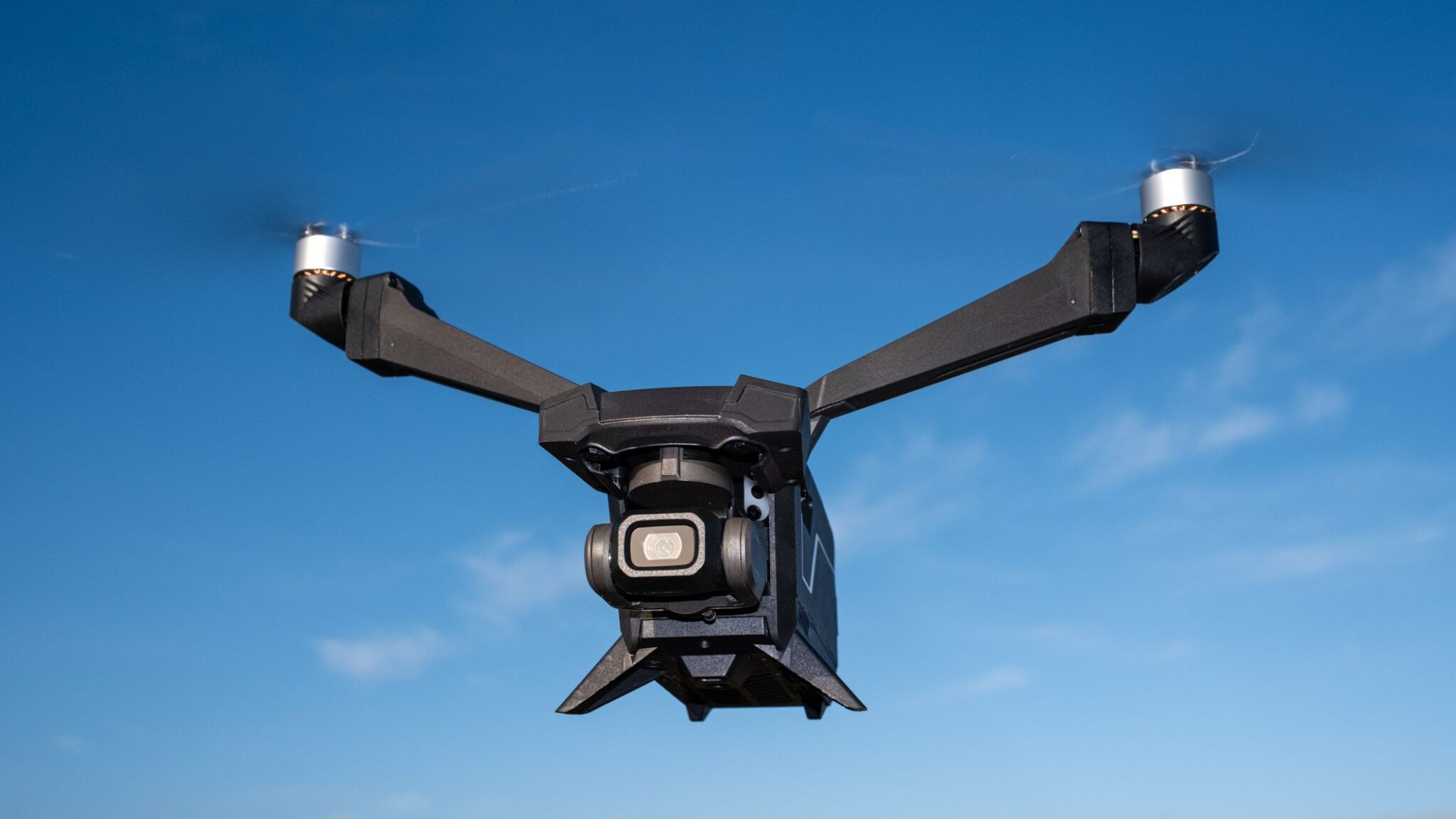
The one thing you cannot get away from is the Falcon Mini’s unique design: it’s a bi-copter rather than a quadcopter, like we’re used to. Not only does this drastically change the way the drone looks, but it also makes the Falcon Mini surprisingly quiet in flight when compared to quadcopters. To compensate for having just two rotors, there are proprietary tilt-rotor controls and twin servo motors that precisely adjust the angles of the propellers to create balance and stability during flight. These also allow for fast acceleration by tilting the propellers.
Moving back to the basic design, as the name suggests, the V-Copter Falcon Mini creates a unique V shape in the sky. At certain angles, only having two propeller arms makes it tricky to see in the sky because it’s such a compact drone.
Folded, the Falcon Mini is just 7.24 x 3.74 x 2.36 inches / 183.9 x 95 x 59.9mm, and it extends to 5.91 x 8.98 x 5.12 inches / 150.1 x 228.1 x 130mm when unfolded, with a weight of 8.78oz / 249g. You can buy the Falcon Mini in two colors: Matte Black and Canary Yellow.
If you opt for the Fly More Combo you’ll benefit from a two-battery charging hub. This is, of course, much quicker for charging batteries than doing it individually in the drone. However, it’s strange that ZeroZero opted for just two battery slots when the Fly More Combo includes three batteries.
ZeroZero claims that the 2330mAh batteries provide up to 34 minutes of flight time, but during testing this was much shorter in real-world flying conditions. Flight times were around 20 minutes until batteries reached 20% and indicated that performance had been limited, and that the drone should be landed. Battery testing took place on a mild winter day in temperatures of around 50F / 10C, so battery life should improve slightly during warmer months, although I can’t see that it would ever reach 34 minutes.
The controller is simply designed and looks quite minimalist, although you have all the direct-access controls you need, including standard control sticks, a Return to Home/Stop button, a flight mode button, a photo button and a video button.
The phone holder folds back and stows away alongside the control sticks, and it’s rotated over to the front to hold your phone above the control sticks for use. With the vertical mode switched on, rotating your phone to portrait orientation sets the Falcon Mini to capture upright photos and videos.
V-Copter Falcon Mini: Features and performance
- Three flight speeds
- Reverse flight (upside-down)
- Agile flight
The Falcon Mini flies just like a standard quadcopter, although it’s considerably quieter. ZeroZero claims that it’s 50% quieter than a quadcopter, which makes sense since it has 50% the propellers and motors. Noise has been measured to be 62 decibels at two meters by ZeroZero, and it’s fair to say that the drone is noticeably quieter than the many quadcopters I’ve flown.
Flight, as previously mentioned, doesn’t feel dramatically different to a quadcopter despite only having two rotors. To compensate for less motors, the rotors tilt forward to boost airflow and generate thrust, with each rotor moving independently to allow for sharper turns. This, combined with the tilting rotors, does mean that the Falcon Mini can accelerate quickly when in its faster flight modes.
Normal mode allows for speeds of up to 8.9mph, Sport up to 26.8mph and Turbo up to 35.8mph. Sport is the mode that you’ll probably use the most, since it’s like Normal on other drones. Normal and Sport are accessed using a button on the controller, while Turbo is accessed via the V-Copter app. This option sits alongside Orbit and Zoom Out automated flight modes and the Reverse Flight Mode. Reverse Flight enables you to fly the Falcon Mini upside down, where it looks like it’s skating in mid-air rather than simply flying.
To do this, you have to refit the propellers upside down and use the Reverse Flight Kit, which is a plastic bracket that locks the propeller arms in their extended/unfolded position. Reverse Flight makes the drone even more agile in some respects, and with the propellers facing down you have to use hand take-offs and landings, which isn’t as bad as it sounds because you can grab the drone’s airframe with your fingers, well away from the propellers.
For Reverse Flight, you’ll definitely need to be outside in an open area to reduce the risk of crashing. When you’re indoors, due to the lack of GPS signal the Falcon Mini goes into an indoor flight mode, in which the drone flies slower and is less responsive. It’s useful, but this isn’t the type of drone you’d typically want to fly indoors, unlike the HoverAir X1 Pro/ProMax with their built-in propeller guards.
Video transmission is 1.5 miles, which suggests the signal isn’t as strong as drones that offer transmission over six miles or more. What I did find during testing is that even when flying the Falcon Mini just a few hundred meters away from me in open space, I did occasionally receive low-signal warnings, and there was sometimes a lag in the camera view on the app screen.
Flight seems to be where the Falcon Mini Excels, thanks to its fast acceleration and agility. Plus, let’s not forget Reverse Flight, which is a bit of a gimmick, but it is unique and takes advantage of the drone’s innovative design. For me, this drone is about as fun as you can get with a camera drone in terms of flight, before you have to move on to FPV drones like the DJI Avata 2 to enjoy the most thrilling flights.
V-Copter Falcon Mini: Image and video quality
- Fully automatic camera
- Up to 4K 30fps video
- Photos captured in JPEG only
The Falcon Mini certainly sits within the camera drone category, and surprisingly comes with an extremely basic camera; this is what makes me think that this is a drone designed more for fun and flying than it is for image creation. The camera features a 12MP 1/2.3-inch CMOS sensor, which appears to be the same spec as the original V-Copter, but it could be a different, newer sensor.
This can capture video in 4K at 30fps, 2.7K up to 50fps and 1080p at 50fps, while vertical video is captured in 2.7K at 30fps. Photos can only be captured in JPEG format, which is a shame because raw files provide more editing flexibility. You capture photos in landscape and portrait format.
V-Copter Falcon Mini video
The camera is fully automatic – you just aim the camera and shoot – so it’s easy to use, but this does mean you have no control over exposure at all. It’s best to shoot with the sun behind the drone to avoid overexposure or underexposure, which does limit creativity somewhat.
Vertical shooting can be initiated by rotating the camera holder on the controller to portrait orientation. This is cropped vertical rather than natively captured vertical, as on the DJI Mini 5 Pro, but it’s still useful for capturing social media-ready footage. You simply have to activate the feature in the app menu, and it appears to use your phone’s accelerometer rather than the position of the phone holder.
Despite having only 50% of the rotors of ‘standard’ camera drones, the Falcon Mini’s 3-axis mechanical gimbal keeps footage smooth and lets you adjust the camera’s angle depending on what you’re shooting, as with most drones.
There’s also a Night Mode for shooting at Night which, in a nutshell, optimizes the automatic camera for night capture. It works well, and I found most photos and videos captured at night to be satisfactory, but you can see heavy image processing in both cases, and the results are far from professional quality.
- Image and video quality score: 3/5
V-Copter Falcon Mini: testing scorecard
|
Attributes |
Notes |
Rating |
|---|---|---|
|
Price |
The drone isn’t expensive, but it should be cheaper than the direct competition. |
3/5 |
|
Design |
The design is undoubtedly unique, and works surprisingly well. |
4/5 |
|
Performance |
The Falcon Mini Flies well, and has the Reverse Flight mode trick up its sleeve. |
4/5 |
|
Image and video quality |
Image quality and camera functionality are what let this fun-to-fly drone down. |
3/5 |
Should I buy the V-Copter Falcon Mini?
Buy it if…
Don’t buy it if…
V-Copter Falcon Mini: also consider
How I tested the V-Copter Falcon Mini
- I tested the drone over a period of several weeks
- I tested all of its features, including image and video capture
- I assessed flight performance in its various modes
I tested the V-Copter Falcon Mini over several weeks, trying out all of the features and functionality, including Reverse Flight (upside-down flight). The drone was used in the same way as other camera drones to assess both flight performance and camera performance. The Falcon Mini was flown through a range of maneuvers to see how smooth and stable flight is with just two sets of rotors.
Read the full article here