



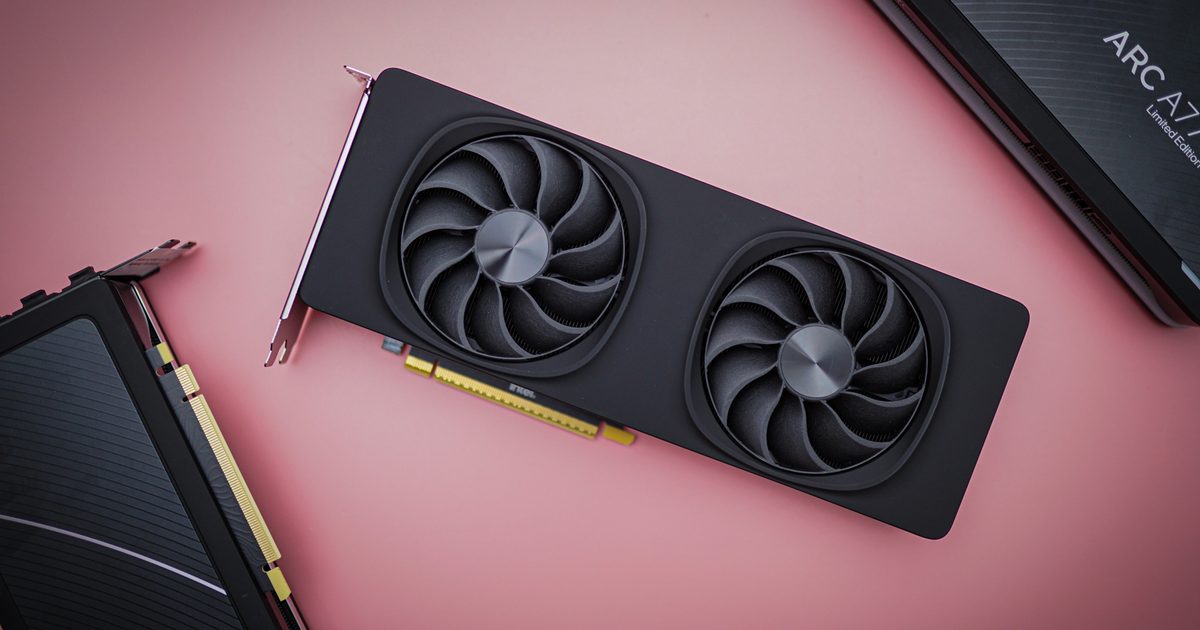

Every year, the GPU market seems to follow a familiar script. Nvidia continues to set the pace at the high end, AMD responds where it can, and the loudest headlines are dominated by flagship performance. For most buyers, that still means choosing between the same two companies — even as the balance of power clearly tilts in Nvidia’s favor.
But the GPU I’m most excited about heading into 2026 doesn’t come from either of the companies. Instead, it’s an unconfirmed card that could quietly change the shape of the market – Intel’s Arc B770, often referred to in leaks as Big Battlemage.
Intel’s journey with its discrete Arc GPUs hasn’t been smooth but it is noteworthy. The first generation arrived with promise but struggled with drivers, consistency, and positioning. Even so, Intel didn’t back away. Instead it quietly fixed the basics by refining and introducing updates for the Arc A-series (Alchemist). More importantly, with the newer B-series (Battlemage), Intel found its footing by focusing on what actually matters to most buyers – usable performance at an aggressive price.
The B-series GPUs, including the B580 and B570, didn’t dominate benchmarks but they earned attention for offering strong value, improving rapidly through driver updates, and undercutting Nvidia and AMD where it counted.
That momentum is what makes the Arc B770 interesting, because it suggests that Intel may no longer be just experimenting but potentially building towards something bigger. To be clear, the B770 isn’t expected to be a flagship in the traditional sense. Instead, it looks like Intel’s first serious attempt at a true midrange performance GPU, aimed squarely at the space where most gamers actually buy hardware.
Why the Arc B770 feels different
At the heart of the rumored Arc B770 is Intel’s larger BMG-G31 Battlemage chip, which has already shown up in developer tools and profiling software, a strong sign that a product is actively being tested rather than merely planned. This chip is expected to be significantly larger and more capable than anything Intel has previously shipped in a desktop Arc card.
Leaks suggest the B770 could feature up to 32 Xe2 cores, marking a substantial jump over the earlier Arc designs. Combined with architectural improvements in Battlemage, this should translate to noticeably better raster performance, stronger ray tracing capabilities, and fewer of the bottlenecks that held earlier Arc GPUs back.
Memory is another area where the B770 could finally feel competitive. Current reports point toward 16GB of GDDR6 memory, likely paired with a wider memory bus than Intel’s previous cards. That matters more than ever, as modern games and creative workloads continue to demand more VRAM. If Intel does land at 16GB as expected, the B770 would immediately avoid one of the most common complaints aimed at midrange GPUs today.
Power draw is also expected to scale up. Some leaks suggest the Arc B770 could be a 300W-class GPU, which may sound high, but it signals Intel is no longer holding back for the sake of efficiency alone. Instead, it suggests a focus on sustained performance, higher clocks, and enough thermal headroom to compete properly in the 1440p gaming segment.

None of this has been officially confirmed, but even Intel’s own actions hint that something larger is coming. Earlier this year, Intel’s gaming social media account briefly acknowledged the Arc B770 in response to a fan question. While the comment was quickly walked back, it was enough to confirm that the name and the product exists internally.
A GPU aimed at where people actually play
What makes the Arc B770 exciting isn’t the idea that it will beat Nvidia or AMD at the top end. Instead Intel could be targeting 1440p gaming, which has been the sweet spot for a majority of PC gamers. This is the resolution where performance, visual quality, and hardware cost tend to balance out, and where competition has felt increasingly narrow.
If the B770 can deliver consistent frame rates at 1440p, handle ray tracing without falling apart, and do so with enough VRAM to avoid memory-related stutters, it could finally give buyers a real third option. It’s something the GPU market hasn’t really offered in a long time
Intel also has the opportunity to differentiate in areas beyond raw performance. Battlemage is expected to bring improvements to media engines, AI acceleration, and upscaling technologies. The company has already shown its willingness to iterate aggressively on software, and a stronger hardware foundation would allow those gains to matter more.
Why this matters beyond one GPU
The Arc B770 isn’t just about Intel proving it can make a faster graphics card. It’s about whether Intel can become a long-term competitor in discrete GPUs. That has implications far beyond a single product cycle.
A credible third player can influence pricing, force better value propositions, and reduce the stagnation that often creeps into two-company markets. Even if the B770 doesn’t top benchmark charts, its mere presence could make the entire midrange GPU space healthier.
Intel’s broader position also gives it unique advantages. Unlike its rivals, it designs CPUs, integrated graphics, and discrete GPUs under one roof. Over time, that could enable tighter integration between components, smarter workload distribution, and features that feel more cohesive across a full system.
The risks are still real
None of this guarantees success. Intel still has to prove that its drivers are reliable at launch, performance is consistent across modern games, along with pricing that makes sense. A powerful GPU that’s poorly priced or unstable won’t win over skeptical buyers especially those burned by earlier Arc launches.
Timing also matters. The GPU market in 2026 will be crowded, and Intel will need to pick its moment carefully. If the B770 launches too late or too close to competing refreshes, its impact could be limited.
Read the full article here