



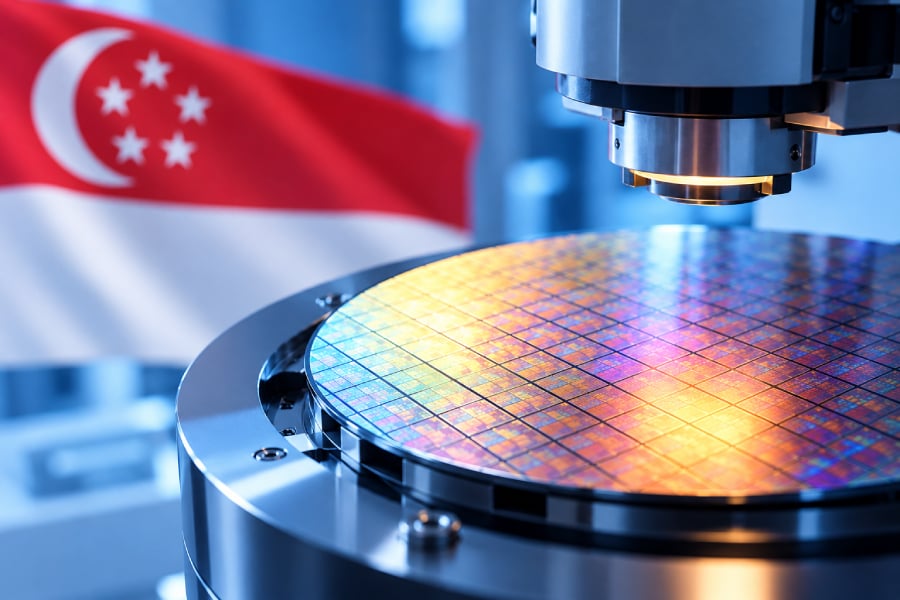

Singapore’s semiconductor industry has added another major manufacturing site with the opening of a $7.8 billion USD chip plant.
VisionPower Semiconductor Manufacturing Company, or VSMC, has opened a new 300mm fabrication facility in Singapore that is expected to produce about 44,000 wafers a month at full capacity. VSMC is a joint venture between Taiwan’s Vanguard International Semiconductor and Dutch chipmaker NXP Semiconductors.
The plant expands Singapore’s role in the global semiconductor supply chain at a time when demand is growing for the specialty chips used across data centers, vehicles, industrial equipment, mobile devices, and consumer electronics.
New Singapore fab targets 44,000 wafers a month
Located in Tampines, the facility has entered risk production, where manufacturing processes are tested and refined before full commercial output.
VSMC said in a report by Global Newswire that it has already processed its first sample lot with yields above 99%. Volume production is scheduled to begin in the first quarter of 2027, with full capacity expected in 2029.
At that point, VSMC expects the plant to produce about 44,000 12-inch wafers per month and employ roughly 1,600 people.
The fab will support process technologies ranging from 130 nanometers to 40nm for mixed-signal, power management, analog, and interposer products.
Those are not the cutting-edge process nodes used for the newest AI accelerators. Instead, they produce chips that handle functions such as power delivery, connectivity, sensing, and control across computing, automotive, and industrial systems.
That makes the plant relevant to the wider AI and data center buildout even without manufacturing GPUs itself. Modern servers and accelerators still depend on large numbers of supporting power-management, analog, and connectivity components.
Singapore adds to its semiconductor manufacturing base
The VSMC plant joins a semiconductor industry that already includes major manufacturing operations from companies such as GlobalFoundries, Micron, Infineon, United Microelectronics Corporation, and Siltronic.
Singapore has spent decades building an ecosystem around chip manufacturing, equipment, research, and electronics production. Its established infrastructure and skilled workforce have helped it attract new semiconductor investments despite higher operating costs than some neighboring manufacturing markets.
The country is also positioned close to growing electronics and semiconductor operations across Malaysia, Vietnam, and the wider Southeast Asian region.
That geographic concentration gives chipmakers access to a broader regional supply chain while allowing them to spread production across multiple manufacturing locations.
What’s hot at TechRepublic
AI is increasing demand for supporting chips
VSMC has pointed to high-performance computing among the markets the new plant will serve, alongside automotive, industrial, mobile, and consumer applications.
The partners also see growing demand from so-called physical AI, where AI systems operate in machines such as robots, vehicles, and industrial equipment.
Those systems require more than processors. They also depend on power-management, analog, communications, and control chips — the kinds of components the Singapore facility is designed to manufacture.
VSMC is also using AI and digital management systems inside the fab itself to improve manufacturing efficiency and production quality.
A second VSMC fab could follow
The $7.8 billion facility may only be the first phase of VSMC’s Singapore investment.
When Vanguard and NXP announced the joint venture, they said a second fab could be considered after the initial facility successfully ramped production.
More recent reporting suggests VSMC is already evaluating that possibility as demand fills capacity at the first plant, although no second facility has been formally announced.
For enterprise technology buyers, the immediate effect will not be more chip supply overnight. Volume production does not begin until early 2027, and the plant is not expected to reach full capacity until 2029.
The longer-term significance is additional manufacturing capacity for the less glamorous but essential chips found throughout servers, networking equipment, vehicles, factories, and other connected systems.
Singapore’s latest semiconductor investment shows that the AI hardware boom is not only driving demand for advanced processors. It is also increasing the need for the supporting chips that keep those systems powered, connected, and running.
Other news: The Asian Development Bank raised its 2026 Southeast Asia growth forecast to 4.7% as AI-linked technology exports and infrastructure investment expand across the region, though gains remain uneven due to differences in power, digital capacity, skills, and costs.
Read the full article here