




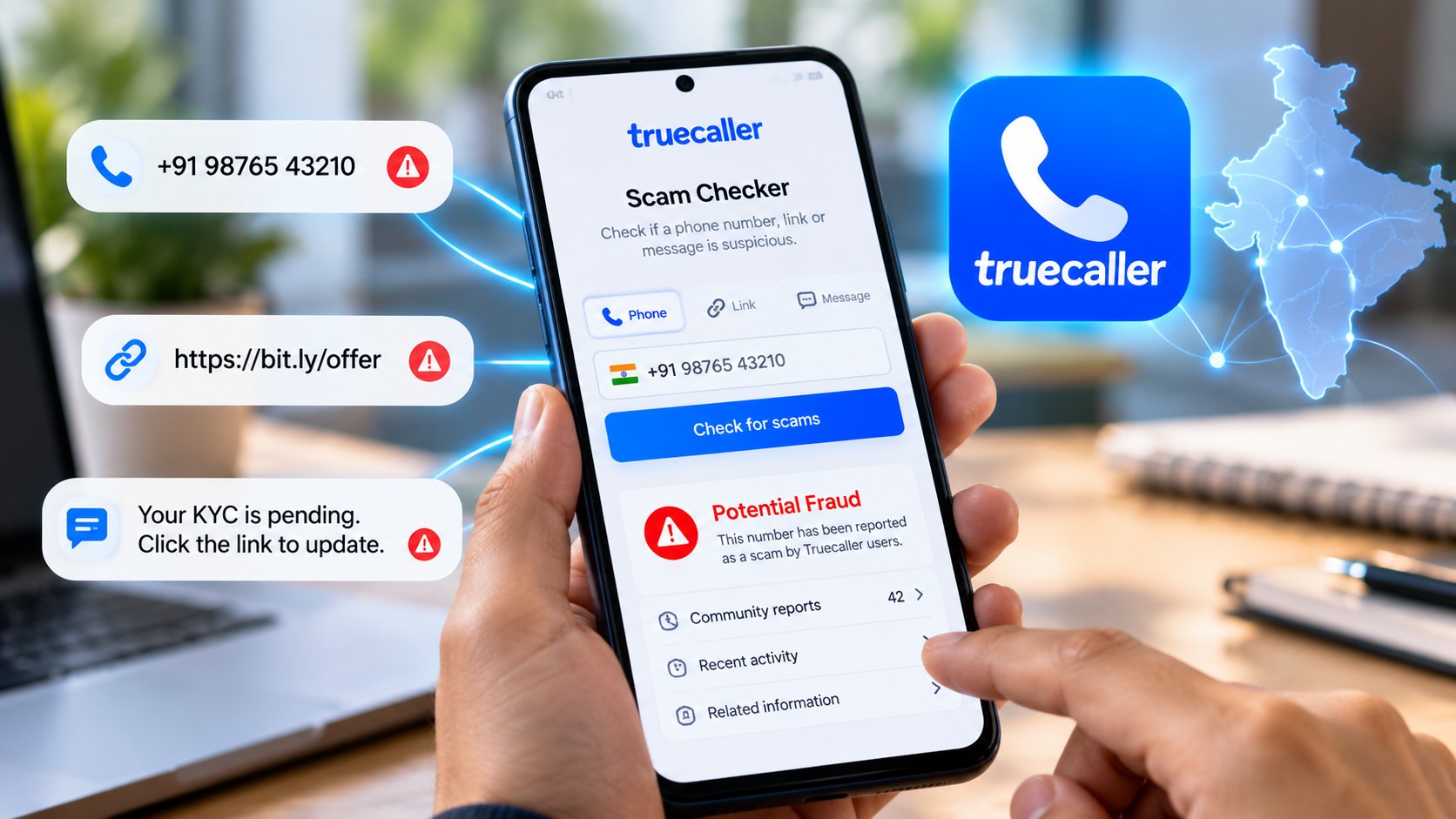

Truecaller launched Scam Checker in India on Sept. 28, giving people a free way to check suspicious phone numbers, links, or messages against the company’s scam-detection systems and community reports.
The tool pushes Truecaller beyond caller ID and spam blocking as fraud increasingly moves through messaging apps and web links. Basic web checks don’t require a Truecaller account, so people can use Scam Checker without installing the main app.
According to Truecaller’s launch announcement, Scam Checker is available globally on the web and in India through its Android app. More regions and iOS support are planned later.
TechCrunch reports that Truecaller also plans to expand the Android service to Latin America, the Middle East and Africa, and Southeast Asia, although no rollout dates have been announced.
How Truecaller Scam Checker works
The Truecaller Scam Checker can assess a phone number, web link, or description of a suspicious message.
For URLs, Truecaller expands shortened links and follows redirects to the final destination. It then compares the site with community fraud reports, known phishing and scam databases, and other domain signals.
Results can label a link as safe, suspicious, or fraudulent and provide information such as the final URL, redirects, domain owner, and registration details.
Phone-number searches return a Safe or Potential Fraud result based on Truecaller’s detection systems and community signals. A basic scam check doesn’t require an account, although identifying the name associated with a number still requires Truecaller’s regular service.
People can also describe a suspicious message or situation in their own words. Scam Checker can identify links or phone numbers in the query and surface related posts from ScamFeed, Truecaller’s user-generated scam-reporting community.
Truecaller told TechCrunch that people make about 14 million web searches each month to check suspicious links and numbers. The company also said roughly 20,000 reports are live on ScamFeed in India, with about 1,300 added each week.
Between Sept. 14 and 20, Truecaller said it evaluated 12.9 billion messages globally and flagged 20.3 million as fraudulent. Those are company-reported detection figures, not an independent measure of accuracy.
Truecaller plans to add broader scam coverage and screenshot uploads in future versions.
What security teams should know
Scam Checker can provide a useful second opinion, but organizations shouldn’t treat a Safe result as clearance to open a link or trust a sender. Truecaller hasn’t published false-positive or false-negative rates for the service.
Its ScamFeed community guidelines also make clear that individual user reports aren’t validated before publication and may not be verified. Truecaller uses automated systems and human review to moderate content after it appears.
The guidelines tell users not to post personal data, financial identifiers, confidential information, or material they don’t have the right to share. ScamFeed submissions also grant Truecaller broad rights to use that content, including for improving fraud detection and training machine-learning models.
For URL checks, Truecaller separately says submitted links are analyzed to produce the verdict and improve scam detection, while the checks aren’t tied to the user’s identity.
The current public material doesn’t spell out retention rules for every type of Scam Checker submission, such as pasted message text or phone-number queries. That makes a cautious approach sensible for workplace use.
Security teams should:
- Keep existing phishing and fraud-reporting channels as the primary route for suspicious messages.
- Avoid pasting credentials, internal URLs, customer records, financial data, or confidential business information into the service.
- Treat a Safe or not-flagged result as one signal, not proof that a link or number is trustworthy.
- Review Truecaller’s privacy and data-handling terms before recommending the tool across an organization.
Truecaller has already been expanding its scam defenses in other areas, including family protection tools that let relatives help manage scam protection.
Truecaller pushes beyond caller ID
Scam Checker arrives as Truecaller broadens its business beyond traditional caller identification.
Earlier this year, TechRepublic reported on new pressure in India as carrier-level caller-name services and built-in protections from Apple and Google increased competition around Truecaller’s core product.
Truecaller’s own 2025 India report said its community identified 41.68 billion spam calls and blocked 11.89 billion of them during the year. It also identified 129.03 billion spam messages and 7.7 billion fraud calls. Those figures describe Truecaller’s classifications across its user base, not audited measurements of all fraud in India.
The company has also moved into voice-clone detection with AI Call Scanner, which analyzes live calls for AI-generated voices. Truecaller’s current support documentation lists the feature in the US, Australia, Canada, and South Africa, with beta access in India.
Truecaller is part of a wider industry push against increasingly cross-platform scams. Google, Microsoft, Amazon, Meta, OpenAI, and other companies have also joined a cross-industry anti-scam accord aimed at sharing fraud signals and tightening safeguards.
For now, Scam Checker is best treated as a quick consumer verification tool rather than a replacement for enterprise URL filtering, email security, or formal fraud investigation. Employees can use it to check an unfamiliar number or link, but suspicious activity should still go through the organization’s established security process.
Also read: Google is also tightening Android sideloading security to make scam-driven app installs harder.
Read the full article here