


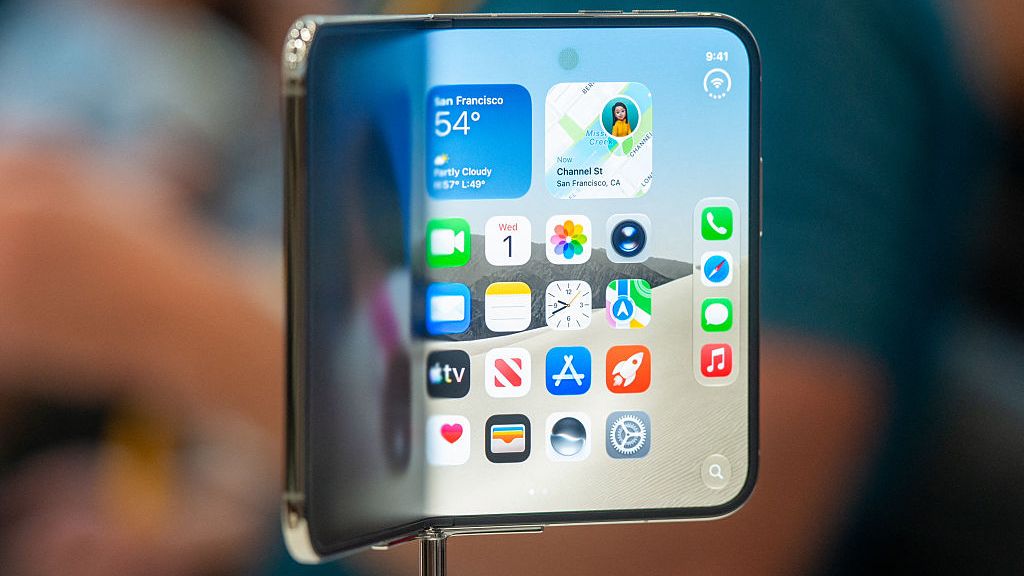

In the midst of hype for Apple’s new A20 Pro chipset and slick foldable software, the company’s durability department is quietly having a moment.
Its Ceramic Shield 2 display glass — first introduced on the iPhone 17 line and returning this year on the iPhone 18 Pro — is earning plaudits for delivering on the promise of 3x better scratch resistance 12 months on from its release, while the iPhone Duo is set to arrive next month with a host of impressive on-paper durability credentials (including, notably, a Galaxy Z Fold 8-beating IP68 resistance rating).
But while features like ingress protection and corrosion resistance aren’t the sexiest topics of discussion at Apple Park, they are some of the most important for ensuring Apple’s products stand the test of time — and Tom Marieb, the company’s new Vice President of Hardware Engineering (a role formerly occupied by CEO John Ternus), knows that better than most.
Latest Videos FromTechRadar
I had the chance to quiz Marieb on the iPhone 18 Pro and iPhone Duo in a group interview at Apple’s London HQ, and he lifted the lid on how Ceramic Shield 2 — which we described as “the first iPhone glass we fully trust” earlier this year — managed to deliver such a noticeable jump in quality versus the original Ceramic Shield, and why he’s “especially proud” of the iPhone Duo’s hinge durability.
“Personally, when I see someone put a screen protector on their iPhone, it makes my skin crawl, because we work so hard to make beautiful front screens,” Marieb told me. “So we very much wanted to develop new coatings that could withstand [scratches], but also make sure that these coatings were wear-resistant as well. We worry about scratching, which is obviously very dependent on having [material that can withstand] very sharp things going into the screen. But we also worry about wear over time; as people use the screen, whether they’ll wear away that surface. And it turns out that those things are a little counterindicated in a lot of materials.
“So we had to try to optimize both of those [qualities] simultaneously […] And I think we finally hit on a nice balance between the two [in Ceramic Shield 2]. We could have made it more scratch-resistant, but it would have been a little less wear-resistant. It’s the long life we’re looking for against both of those loads over time.”
We very much try to say, ‘How are customers actually using this? What exactly are they exposing it to in the real world?’ And we make tests that mimic those things.
Tom Marieb, VP of Hardware Engineering, Apple
Marieb added that, in testing Ceramic Shield 2, Apple accounted for half a decade’s worth of use in a comparatively minuscule testing period: “We very much try to meet the customer where they live, and so we don’t design tests that measure old military specs or old standards; we very much try to say, ‘How are customers actually using this? What exactly are they exposing it to in the real world?’ And we make tests that mimic those things.
“And as you said, people waiting a year or two to actually see the benefits of [Ceramic Shield 2] means we’ve correctly predicted how people would use it. We accelerate time to try to compress those things into the engineering cycle, so that we can feed back as we try one thing after another, and can represent five years of life — or even more — within a couple of weeks of testing.”
It all hinges on the hinge
The display is the most important part of any iPhone, but the foldable iPhone Duo saw Apple tasked with protecting a new, equally crucial component: the hinge.
Like any foldable, the Duo can be used open or closed, and Apple has also developed dedicated ‘Seated’ or ‘Standing’ modes that will see the Duo bent at various angles for extended periods. The former displays visual content on the top half of the screen and viewing controls on the bottom (picture a Game Boy Advance), while the latter turns the Duo into a bedside clock, photo gallery, or weather screen via StandBy.
Whichever orientation you choose, the Duo remains fixed in place — but the work to make that happen wasn’t easy.
“I’m glad you hit on this, because this is something I’m especially proud of, and it took us a long time [to crack],” Marieb explained. “What we worry about with this device is that people see how thin it is and they think it’s fragile. People seem to be worried about the Air, too, but it’s honestly one of the most reliable phones we’ve ever made. And so we thought, ‘How do we design a hinge that feels very solid when you close it, but also really solid when you open it?’
“We really worked on the torque profile very heavily, and that means changing a lot of the mechanical properties of the hinge to have it feel solid, like a high-end automobile’s car door, when you shut it. That was design intent, so people would have a feeling like, ‘Oh, it’s okay. This is well crafted, and it’s safe for me to use and not worry about it.’
And then, as you said, we have a lot of use cases where the Duo is [in a half-folded state]. And so we also had to think, ‘Can people interact with this [device] and not have it feel floppy?’ So getting those torque profiles right at both those ends, as well as in the middle — not having it feel like you’re pulling something open, and not feeling as if it’s floppy — we spent a lot of time optimizing that. So thank you for noticing, because a lot of blood, sweat, and tears went into that.”
The dual benefits of nano texture
On top (literally) of the iPhone Duo’s hinge, Apple has equipped its first foldable phone with a 7.6‑inch nano‑texture display. This new material isn’t a million miles away from the anti-reflective nano-texture glass that can be added to the best MacBooks, though, of course, the Duo version of said glass needs to bend in half.
Another journalist in my group interview with Marieb noted that foldable creases typically appear minimal out of the box, but become more prominent mere months after being used extensively. In response, the Apple executive was bullish on the longevity of the Duo’s hinge and explained that the nano‑texture display should help maintain its obscurity:
“Hold us accountable to that, please. The choice of a matte finish — apart from it being beautiful — is part of that equation. When you look at glossy displays, their specularity makes it very easy to pick up topology differences. That’s part of the reason we picked the matte finish — it’s not only beautiful in terms of preventing glare, but it’s also more forgiving of [hinge] changes over time.”
Apple, then, is supremely confident in the durability credentials of its first foldable phone — and we look forward to putting the iPhone Duo through its paces ahead of its official launch on October 23. For our full verdict on Apple’s latest candybar handsets, check out our iPhone 18 Pro and 18 Pro Max review.
Follow TechRadar on Google News and add us as a preferred source to get our expert news, reviews, and opinion in your feeds. Make sure to click the Follow button!
And of course you can also follow TechRadar on TikTok for news, reviews, unboxings in video form, and get regular updates from us on WhatsApp too.
Read the full article here