


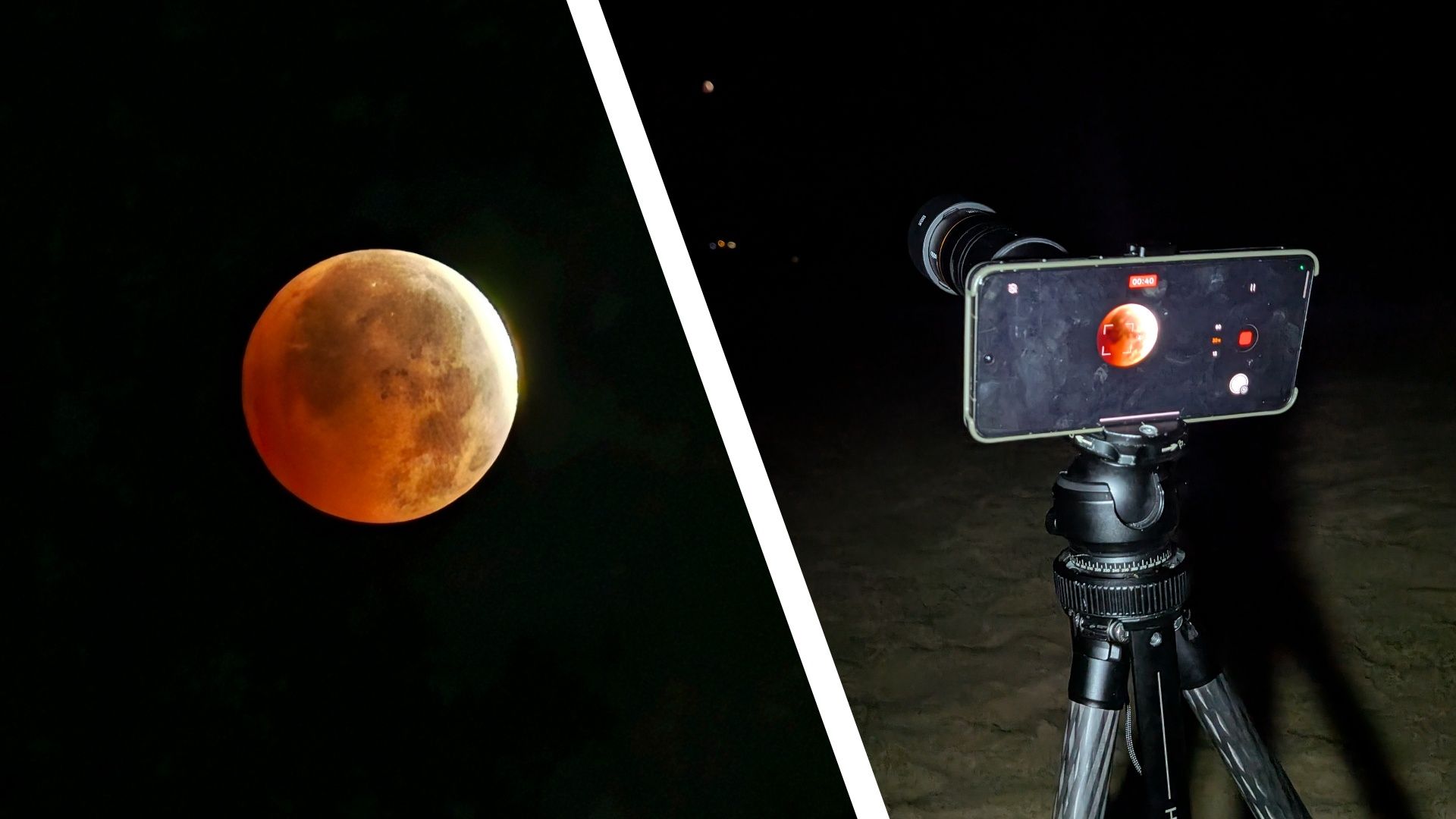

A near-total lunar eclipse occurred last week. I was on vacation at the time, with no serious camera gear for a few windy and soggy days camping on the southwest-facing Wales coastline in the UK. However, I had packed the Oppo Find X9 Ultra, together with its 300mm (13x) teleconverter lens.
The eclipse felt like a perfect test for the flagship phone’s camera skills. Where I was and Europe, the maximum 96.2% eclipse took place an hour before moonset / sunrise, meaning the moon would be low in the sky, while in North and South America it was in the middle of the night with the moon higher up.
Having set my alarm for a horribly early hour, I poked my head out of my tent at 4:15am to check on the weather, and was greeted with an enticing view of the eclipse underway in its partial phase, ahead of its maximum.
Latest Videos FromTechRadar
Excitedly, I threw on some clothes, picked up the Oppo kit and a tripod, and hiked down to the beach to get set up ahead of the eclipse’s maximum, which would take place about an hour later.
Clouds covered the moon before I was able to fire up the camera, but I patiently waited. And despite not being able to see much of the partial phase of the eclipse, fortunately, a break in the clouds meant that I got to see the moon’s eclipse at its maximum — and I was able to see what the Oppo kit was capable of.
Setting up for photographing the eclipse with a phone
The Oppo Find X9 Ultra is the only current phone with a 10x optical lens (the Galaxy S23 Ultra was Samsung’s only previous effort), with a 230mm effective focal length that works pretty well for moon photography by itself. However, for an even closer view, the teleconverter lens is a better bet.
The teleconverter is a proper add-on lens that’s designed to work with the phone’s better-quality 3x optical lens, providing a 300mm equivalent focal length. Oppo notes this as a 13x zoom in the dedicated ‘Hasselblad Teleconverter’ mode in the camera app, which can be increased to 30x (690mm) or 60x (1380mm) digitally.
You’ll need to use a tripod to stabilize the phone, and to capture sharp shots of distant subjects, especially in low light — I used a Heipi 3-in-1 tripod, which includes a dedicated phone clamp within its ballhead.
I like taking manual exposure control for astrophotography, but sadly the phone’s dedicated mode for the teleconverter is stripped back (I’ve previously tried it for sports photography and came away frustrated by the experience).
There are the three zoom settings, a ‘stage’ mode, ±2EV exposure compensation, and then a basic array of controls which includes Auto HDR, aspect ratio, timer and interval shooting modes. That’s about it.
I missed having the option to shoot in RAW format, exposure bracket (to get more detail from the light and dark parts of the moon), increase resolution from 12MP to 50MP and manually set white balance, shutter speed and ISO, which would otherwise be possible in the phone’s ‘Hasselblad Master’ mode (Oppo’s version of a Pro mode).
My desire for manual control was magnified when the phone completely underexposed the moon when in photo mode (see above), which felt odd given that when I switched to video mode — where 4K up to 60fps with Dolby Vision, Ultra Steady stabilization and focus lock are available — the exposure was fine.
It’s actually possible to use the teleconverter lens in the Hasselblad Master mode with the 3x camera and gain those manual controls, instead of the simplified dedicated mode. However, the image is upside down (since the teleconverter’s optical construction comprises mirrors, to keep its size down), plus you lose the digital zoom capabilities — so composing the shot was highly impractical when working in reverse.
The teleconverter is a serious bit of gear, but the mode that’s designed to work with it would benefit from inheriting some of the serious controls the phone is capable of (which could be entirely possible with a firmware update).
Still, I found a workaround — with a quick response taking the photo immediately after switching from video recording to photo, I was able to snap shots of the moon before the exposure went too dark again. Not ideal, but it worked.
How good are the images?
I wasn’t able to compose a shot with the moon framed by landmarks or a point of interest but, simply put, the tripod-mounted Oppo Find X9 Ultra with teleconverter lens delivered the best-quality eclipse photos I’ve got of the moon so far with a phone.
The 13x setting of the teleconverter is best, but the 30x digital zoom setting is usable too. Detail using the 60x setting was too soft for my liking. But the fact that I’ve been able to get such a close-up image of the moon during a near-total eclipse, with a phone and teleconverter lens, shows how far smartphone cameras have come.
I’d still opt for my mirrorless or DSLR camera with telephoto lens for the best-quality moon photography but, having previously written off phones for the task, I could happily pack light with just the X9 Ultra instead.
Follow TechRadar on Google News and add us as a preferred source to get our expert news, reviews, and opinion in your feeds.
Read the full article here